

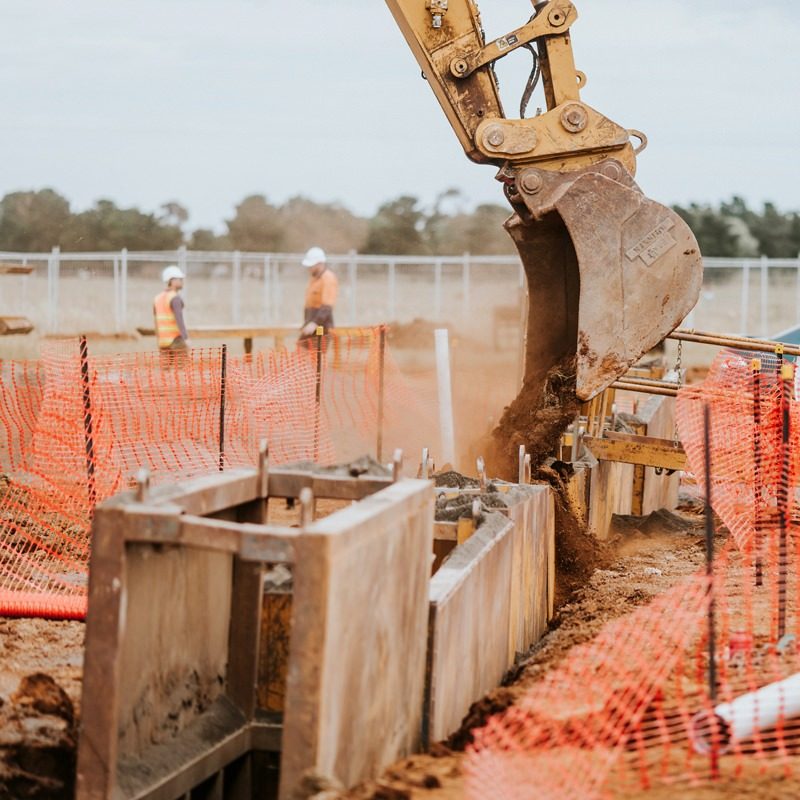
Trenches are everyone’s responsibility
The correct construction and monitoring of trenches is crucial for everyone’s safety.
Trenches can have the potential to pose risks to any worker on site if regulations are not followed. If you’re on a worksite, make sure you know the risks around you.
If controls are not in place, see your supervisor.
Have you checked the following controls to make you’re the trenches on your site are safe, per your relevant excavation codes of practice?
- Trenching notifications (Victoria)
- Excavation controls in place
- Barrricades in place
- Safe access and egress implemented and maintained.
- Benching requirements
- Battering requirements
- Trench shield selections
- Protection around the trench
General
- After all services have been located and clearly marked and excavations are underway, controls must be in place.
- For all trenches 1.5m and greater in depth a trenching notification must be completed.
- When a trench over 1.5m is excavated controls must be in place, trenches must be battered, benched or shields installed before any person can enter the trench.
- Trenches must be appropriately barricaded during works to ensure all fall risks are controlled or if any trenching is to be left open. More substantial barricading such as temp fencing may be required.
- Safe access and egress to the trench must be implemented and maintained. Ladders must be in good condition and positioned so personnel can only enter into the controlled areas.
No one can enter a trench over 1.5m in depth without appropriate controls in place.
- Benching (excavated steps)
- Battering (excavated slopes)
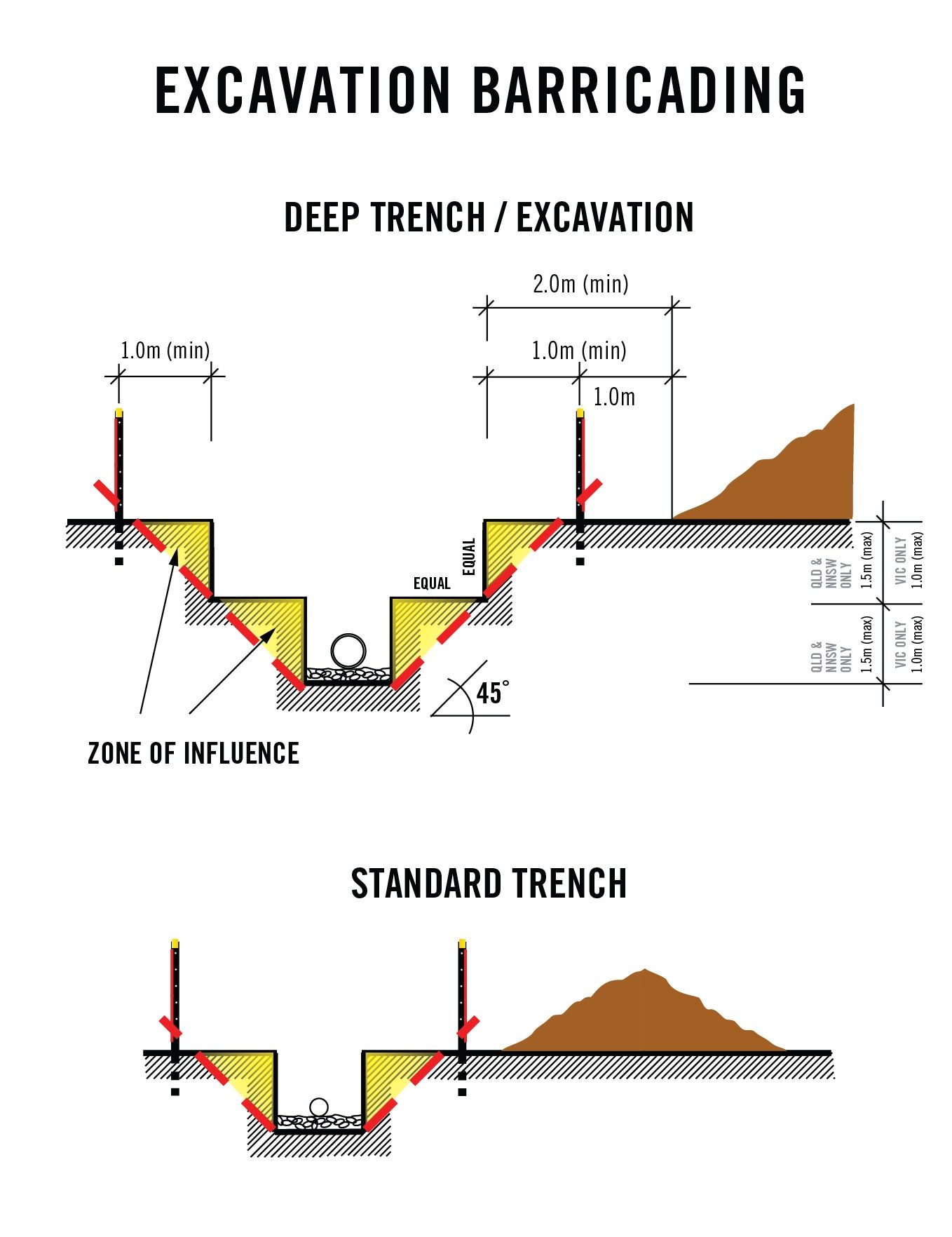
Benching or battering creates excavated steps or slopes, which should provide appropriate control from ground collapse.
That is, the steps or slope will not slump when left for a considerable period, there will be no movement of material down the slope and the toe of the slope will remain stable.
TRENCH SHIELD SELECTION
Trench shields are used during trenching works to protect workers from being engulfed by ground collapse.
Trench shields however, do not prevent ground collapse but provide a protected area for the worker to undertake their task. It is imperative that any worker engaged in trenching work where trench shields are used as protection remains within the protected area of the shields at all times.
The main consideration when choosing controls should be soil conditions. Hard compact soil is the type that causes misconceptions because the face ‘looks good’ and this often leads to risks being taken. With loose or running material, the need for safety precautions is obvious from the start.
When selecting the correct trench shield, the conditions of the environment in which the equipment is to be used need to be considered, including:
- the nature of the soil, including the type, moisture content and water table
- ground stability and any anticipated ground vibration from nearby machinery or road traffic
- expected ground pressures, including the location of the spoil pile and equipment to be used
- the size of the trench or excavation
- any space constraints
- the existence or proximity of underground services
- the type of road traffic and plant near the site, and
- the system of work to be used with equipment
A SWMS is required to be developed for all high-risk construction activities prior to the work commencing.
PROTECTION AROUND A TRENCH
Fall protection controls may include but are not be limited to:
• Extending trench shield sides out of the ground at least 900mm
• Fitting trench shield systems with an attachable guardrail system. Where possible, this should be fitted before installing the trench shields
• Having fall protection during installation of trench shields
• Keeping fall protection during access/egress
• Exclusion zones of at least 2m were possible around the excavation works that is physically defined.